SponCite research note
Clinical feasibility needs a site-agency layer
Sponsors need current, evidence-supported readiness signals. Sites need agency over how their capabilities, constraints, and availability are represented. SponCite starts with current, Site-owned readiness evidence and transparent feasibility.
Sites maintain current readiness
Capabilities, constraints, capacity, startup realities, equipment, and operating context stay closer to the teams that know them.
Studies express real requirements
Sponsors define protocol burden, timelines, feasibility questions, evidence needs, and operational constraints before ranking sites.
Matches stay transparent
In SponCite's controlled capability direction, AI agents can structure evidence and rationale, while regulated decisions remain reviewable, auditable, and human-owned.
Clinical feasibility is often described as a sponsor-side search problem: find enough investigators, send questionnaires, wait for responses, and select sites. But that framing misses the part of the workflow that creates most of the friction.
Sites are not static database rows. They are busy clinical teams with changing capacity, equipment availability, competing studies, staff constraints, local startup realities, and operational context that goes stale quickly.
SponCite starts from a different premise: feasibility improves when sites have agency over how their current readiness is represented, and sponsors can see the evidence and reasoning behind a match.
The problem
The stale-profile problem
A site can look excellent on paper and still be the wrong choice today. The missing signal is usually not whether the site has ever worked in a therapeutic area. It is whether the site is ready for this study, with this protocol burden, this equipment requirement, this recruitment pressure, and this startup timeline.
The wedge
A current-readiness loop
- Site-owned readiness profiles
- Sponsor-site secure connection
- CDA-gated feasibility workflows
- Reusable questionnaires and evidence trails
- Transparent site-ranking rationale for human review
Product surface
Transparent matching beats black-box ranking
In high-stakes study operations, a ranked list is not enough. A sponsor needs to understand why a site appears, what evidence supports the recommendation, what assumptions are being made, and what risks need human review.
That is the role of a glass-box match: not to replace human judgment, but to make the decision surface structured enough that human review is faster, fairer, and easier to audit.
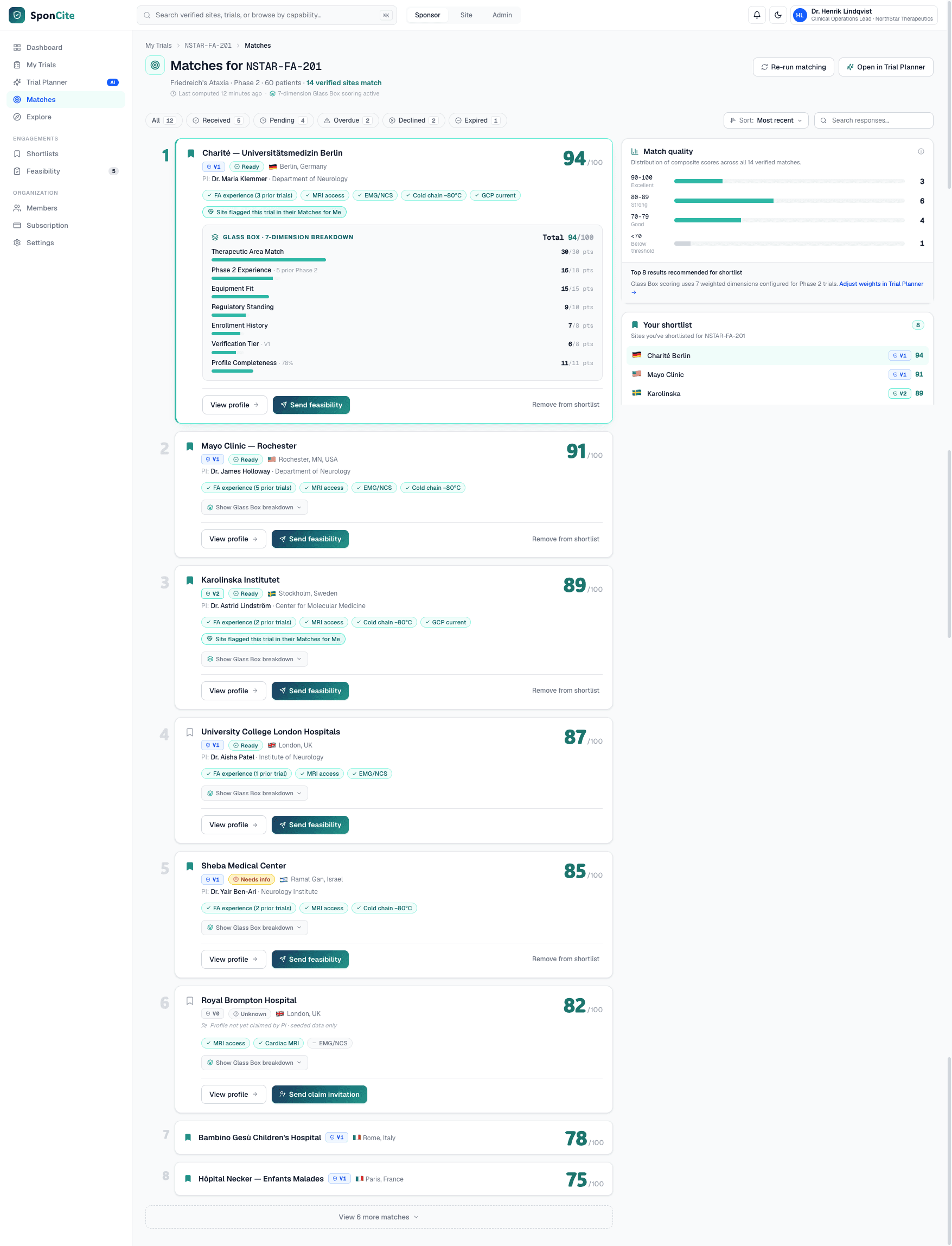
Prototype visual: evidence-supported matching and rationale surfaces for human review.
Why start before PHI
The first SponCite wedge is deliberately designed around site, study, readiness, and feasibility data — not patient-level runtime data.
That matters. It lets the product prove workflow value while keeping the first phase focused on limited-risk AI, human-reviewed decisions, and sponsor-site collaboration.
The future roadmap can expand into protocol intelligence, shared study planning, document workflows, startup, financials, data capture, and evidence graphs. But each new layer should be earned by validated workflow pull, not claimed before it is built.
North star
The bigger translational R&D operating layer
Site discovery is the wedge. The larger opportunity is a translational R&D operating layer that connects preclinical evidence, protocol design, site readiness, study startup, execution workflows, and long-term learning.
Today, those pieces are scattered across tools and teams. The connective tissue is where an AI-native product can create leverage — if it stays grounded in real operational work.
The path
Start with the pain teams already feel.
Build a useful site-agency loop, prove that it improves feasibility work, then expand one validated workflow at a time.